Neck & Back Pain Relief Without Surgery | Patient Guide
Neck & Back Pain in Daily Life: A Patient’s Guide to Relief Without Surgery
“Roz Mobile Aur Office Ka Kaam… Phir Dard Kyun?”
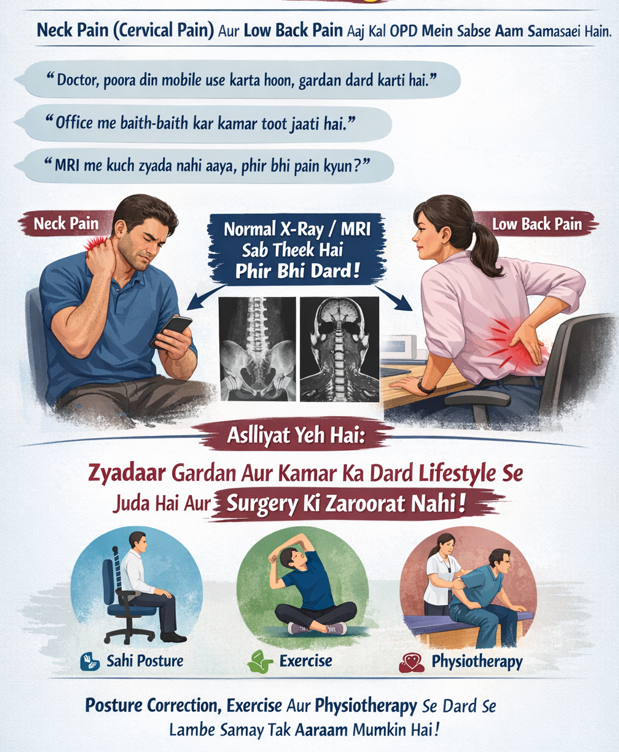
Neck pain (cervical pain) and low back pain are among the most common problems seen in OPD today.
Patients frequently complain of pain despite normal X-ray or MRI reports.
- “Doctor, poora din mobile use karta hoon, gardan dard karti hai.”
- “Office me baith-baith kar kamar toot jaati hai.”
- “MRI me kuch zyada nahi aaya, phir bhi pain kyun?”
👉 The reality is that most neck and back pain is lifestyle-related and
does NOT require surgery.
With posture correction, exercises, and physiotherapy, long-term relief is possible.
What Is Cervical Pain and Low Back Pain?
Cervical Pain (Neck Pain)
Cervical pain arises from the neck (cervical spine) and may spread to shoulders,
upper back, or sometimes arms.
Low Back Pain
Low back pain affects the lumbar spine and may remain localized or radiate to hips or legs,
especially after prolonged sitting.
Why Are Neck & Back Pain So Common Today?
The human spine is designed for movement, not prolonged sitting.
Modern lifestyle habits are the main reason for increasing pain even in young adults.
- Excessive mobile phone use (“text neck”)
- Long hours of computer work
- Poor sitting posture
- Lack of back support
- No regular exercise
- Weak neck and core muscles
- Stress-related muscle tightness
Role of Mobile Use in Cervical Pain
When you bend your neck forward to look at a mobile screen, the load on the neck increases drastically.
- Normal head weight: ~5 kg
- 30° neck bend: ~18 kg load
- 60° neck bend: ~27 kg load
⚠️ This leads to muscle spasm, disc stress, and chronic neck pain,
commonly known as Text Neck Syndrome.
Office Work & Sitting: Enemy of the Lower Back
Prolonged sitting increases pressure on spinal discs and weakens core muscles,
especially when posture is incorrect.
- Slouched sitting strains the lower back
- No lumbar support increases disc pressure
- Continuous sitting reduces blood flow to muscles
👉 Sitting for long hours is more harmful to the spine than moderate physical work.
Common Symptoms Patients Experience
Cervical Pain Symptoms
- Neck stiffness
- Pain while turning head
- Shoulder tightness
- Headache originating from neck
- Tingling or heaviness in arms (occasionally)
Low Back Pain Symptoms
- Pain after prolonged sitting
- Morning stiffness
- Pain while bending forward
- Difficulty standing after sitting
- Relief while lying down
⚠️ Most patients suffer from muscle-related pain, not serious spine disease.
Real-Life Patient Examples
Example 1: Office Worker With Chronic Neck Pain
A 32-year-old software engineer had neck pain and headaches for 6 months.
MRI showed only mild cervical disc bulge.
After posture correction, physiotherapy, and reduced mobile use,
his pain reduced by nearly 80% within 6 weeks.
Example 2: Housewife With Chronic Back Pain
A 40-year-old woman had low back pain during household work.
X-ray was normal. The cause was weak core muscles and wrong bending technique.
After physiotherapy and strengthening exercises, pain improved significantly.
Do All Neck & Back Pain Need MRI?
❌ No. Most patients do not need MRI initially.
MRI Is Required Only If:
- Severe pain with weakness
- Progressive numbness
- Loss of bladder or bowel control
- Pain not improving with treatment
👉 Early MRI often increases fear without changing treatment.
Physiotherapy: Kab Aur Kaise Fayda Hota Hai?
Physiotherapy is one of the most effective treatments for neck and back pain
when surgery is not required.
Physiotherapy Helps When:
- Pain is posture-related
- Muscles are weak or tight
- Pain is recurrent
- Surgery is not indicated
Benefits of Physiotherapy
- Reduces pain and muscle spasm
- Improves posture
- Strengthens neck and core muscles
- Prevents recurrence
- Avoids surgery in most cases
Common Physiotherapy Techniques
- Postural correction
- Stretching exercises
- Strengthening exercises
- Manual therapy
- Heat therapy / TENS
- Ergonomic training
Exercises: Safe or Dangerous?
❌ Wrong exercises can increase pain.
✅ Correct, patient-specific exercises help healing.
Exercises should always be gradual and supervised initially.
Random internet exercises may worsen the condition.
Role of Ergonomics
- Mobile screen at eye level
- Laptop screen at eye height
- Chair with proper back support
- Feet flat on the ground
- Breaks every 30–40 minutes
Do Patients Need Surgery?
❌ In most cases, NO.
Only 5–10% of patients with severe nerve compression require surgery.
Most patients improve with conservative treatment like physiotherapy and lifestyle correction.
Common Patient Myths
- “Neck pain means disc problem” ❌
- “Back pain always needs surgery” ❌
- “Rest is better than exercise” ❌
Reality: Movement + physiotherapy leads to recovery.
When Should Patients Worry?
- Pain radiating to arms or legs with numbness
- Weakness in hand or foot
- Night pain disturbing sleep
- Sudden severe pain after injury
Doctor’s Advice for Patients (Dr Abhijeet)
Neck and back pain are usually lifestyle-related problems, not permanent damage.
With posture correction, physiotherapy, and regular exercises,
patients can live pain-free without surgery.
गर्दन और कमर दर्द: बिना ऑपरेशन राहत पाने की मरीज गाइड
गर्दन और कमर दर्द क्यों होता है?
आजकल ज्यादा मोबाइल इस्तेमाल, लंबे समय तक बैठना और कम शारीरिक गतिविधि
रीढ़ की हड्डी को कमजोर बना देती है।
मोबाइल और ऑफिस वर्क का असर
- मोबाइल झुकाकर देखने से गर्दन पर ज्यादा दबाव
- लंबे समय तक बैठने से कमर कमजोर
आम लक्षण
गर्दन दर्द
- गर्दन में जकड़न
- सिर घुमाने में दर्द
- कंधों में अकड़न
कमर दर्द
- बैठने के बाद दर्द
- झुकने में परेशानी
- सुबह अकड़न
फिजियोथेरेपी से कब फायदा होता है?
- जब दर्द बार-बार हो
- जब मांसपेशियां कमजोर हों
- जब ऑपरेशन की जरूरत न हो
👉 सही फिजियोथेरेपी से ऑपरेशन से बचा जा सकता है।
डॉक्टर की सलाह (डॉ अभिजीत कुमार)
गर्दन और कमर दर्द बीमारी नहीं, चेतावनी है।
अगर आज से posture, exercise और physiotherapy पर ध्यान दिया,
तो आप बिना ऑपरेशन पूरी तरह ठीक हो सकते हैं।