Thyroid Disorder in Patients: Symptoms, Tests & Long-Term Care
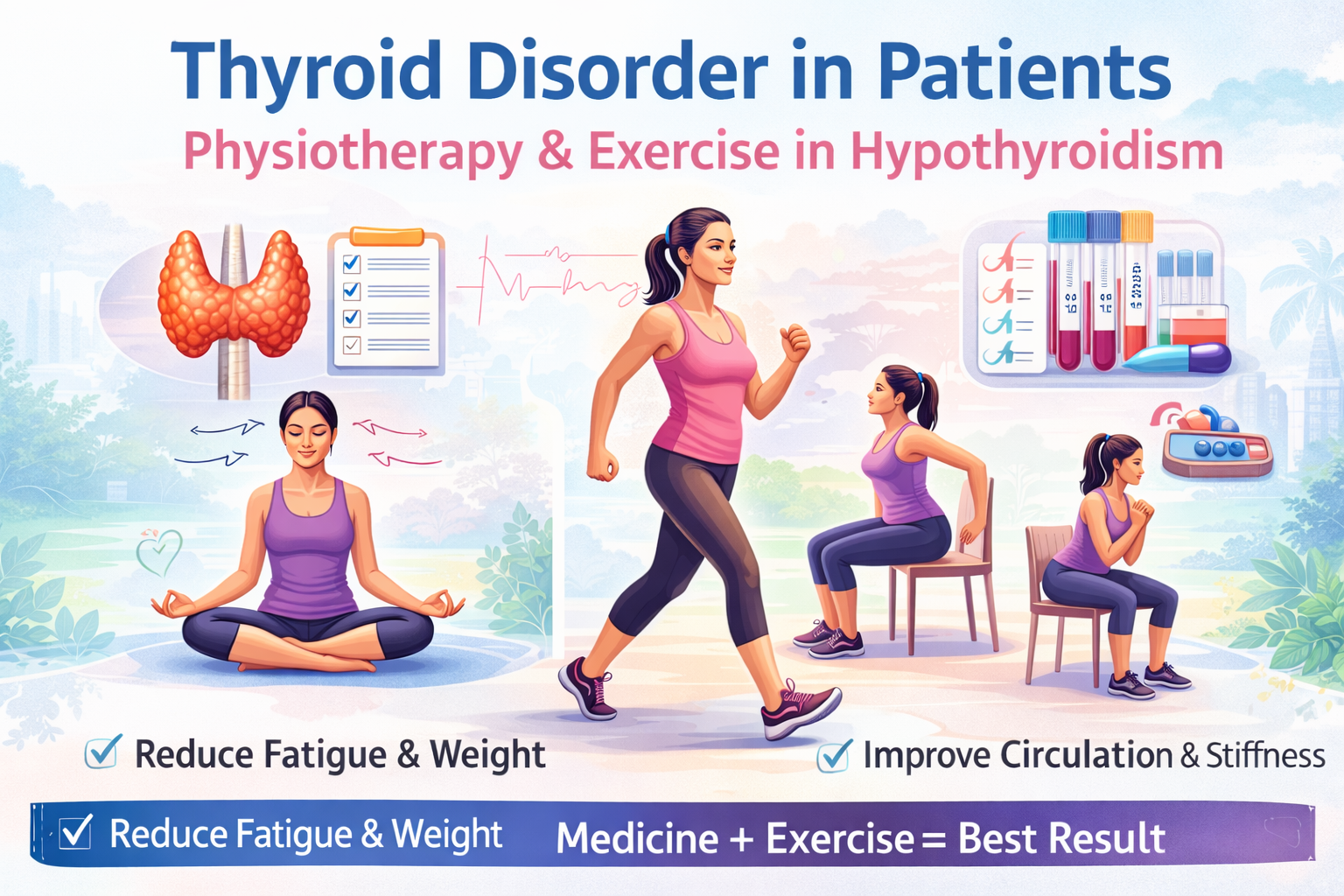
Role of Physiotherapy & Exercise in Hypothyroidism
“Thyroid Hai… Kya Zindagi Bhar Dawa Aur Thakaan Rahegi?”
Patients with hypothyroidism (low thyroid) commonly visit OPD with confusion and fear.
- “Doctor, kya thyroid ki dawa zindagi bhar leni padegi?”
- “Exercise karne ke baad bhi weight kam kyun nahi ho raha?”
- “Thakaan itni hoti hai ki walk bhi mushkil lagti hai.”
- “Physiotherapy se thyroid mein fayda hota hai kya?”
👉 Important truth for patients:
Medicines correct hormone deficiency, but exercise and physiotherapy correct the body’s response to hormones.
Without physical activity, patients continue to feel tired, stiff, and overweight—even with normal TSH.
This blog explains hypothyroidism + physiotherapy exercise process so patients clearly understand:
- Why exercise is needed
- Which exercises are safe
- How physiotherapy helps weight, fatigue, stiffness, and mental health
- Common mistakes patients make
- Long-term care approach
Understanding Hypothyroidism in Simple Words
Hypothyroidism means the thyroid gland is producing less thyroid hormone than required.
Because thyroid hormone controls metabolism, its deficiency causes:
- Slow energy production
- Easy weight gain
- Muscle stiffness
- Joint pain
- Fatigue
- Depression-like symptoms
👉 Medicine replaces hormone, but muscles, joints, heart, and lungs still need training.
That is where physiotherapy-based exercise becomes essential.
Why Exercise Is Essential in Hypothyroid Patients
- Muscles become weak and stiff
- Metabolism slows down
- Fat burns slowly
- Heart rate remains low
- Joint lubrication reduces
👉 Physiotherapy exercises:
- Reactivate slow muscles
- Improve circulation
- Reduce stiffness
- Increase calorie burning safely
- Improve mood and sleep
Common patient complaint:
“Dawa le raha hoon, par body abhi bhi heavy lagti hai.”
Can Exercise Cure Thyroid?
❌ No. Exercise does NOT replace thyroid medicine.
✅ But exercise:
- Improves response to medicine
- Reduces symptoms
- Helps dose stabilization
- Prevents weight-related complications
👉 Think of medicine as fuel, and exercise as engine tuning.
Physiotherapy Exercise Process for Hypothyroidism
(Explained Fully in Sentence Form)
STEP 1: Initial Physical Assessment
Before starting exercises, a physiotherapist evaluates fatigue level, muscle tightness, joint stiffness,
breathing pattern, heart rate response, and weight-bearing tolerance.
👉 This ensures exercises are safe, gradual, and personalized.
STEP 2: Breathing & Circulation Activation
Hypothyroid patients often have shallow breathing, low oxygen utilization, and poor circulation.
Deep Breathing Exercise:
The patient sits comfortably, inhales slowly through the nose for 4 seconds, feels chest and abdomen expansion,
and exhales slowly through the mouth for 6 seconds.
- Improves oxygen delivery
- Reduces anxiety
- Prepares body for activity
👉 Performed 5–10 times, twice daily.
STEP 3: Neck & Shoulder Mobility Exercises
Due to poor circulation and stress, many hypothyroid patients develop neck stiffness, shoulder tightness,
and upper back pain.
The patient performs slow neck bending forward/backward, side-to-side movements, and gentle shoulder rolls.
👉 Movements improve blood flow near thyroid region, reduce stiffness, and improve posture.
⚠️ Always slow and pain-free.
STEP 4: Low-Impact Aerobic Exercise
Brisk Walking (Physiotherapy Gold Standard)
- Start with 10–15 minutes daily
- Gradually increase to 30–45 minutes
- Maintain pace where patient can talk but not sing
- Improves metabolism
- Burns fat safely
- Improves heart health
- Reduces depression
👉 Walking is preferred over running initially.
STEP 5: Muscle Strengthening Exercises
Hypothyroidism causes weakness in thighs, hips, back, and arms.
Physiotherapy Strength Training:
- Chair-supported squats
- Wall push-ups
- Resistance band exercises
These exercises increase muscle mass, improve insulin sensitivity, and increase calorie burning even at rest.
👉 Done 2–3 days per week.
STEP 6: Flexibility & Joint Mobility
Many patients complain of morning stiffness and body pain.
- Hamstring stretch
- Calf stretch
- Back stretch
👉 Reduces stiffness, improves joint nutrition, and prevents injury.
STEP 7: Yoga Therapy (Supportive)
- Bhujangasana
- Setu Bandhasana
- Anulom-Vilom breathing
Yoga reduces stress hormones, improves sleep, and supports hormonal balance.
⚠️ Avoid extreme poses or breath holding.
STEP 8: Fatigue Management Training
- Energy conservation techniques
- Breaking tasks into smaller steps
- Rest–activity balance
👉 Prevents burnout and exercise dropout.
Real-Life Patient Examples
Example 1: Weight Gain Despite Medicine
A 40-year-old woman on thyroid medicine for 2 years had weight gain, stiffness, and fatigue.
After physiotherapy-based walking, strengthening, and stretching,
weight stabilized and stiffness reduced in 8 weeks.
Example 2: Fear of Exercise
A 26-year-old woman avoided exercise due to fatigue.
With gradual breathing, slow walking, and gentle strengthening,
confidence improved and energy increased without flare-ups.
Common Exercise Mistakes
- Over-exercising suddenly
- Crash workout plans
- Skipping warm-up
- Comparing progress with others
- Inconsistent routine
👉 Physiotherapy focuses on consistency, not intensity.
How Often Should Hypothyroid Patients Exercise?
- Daily light activity (walking, stretching)
- Strength training 2–3 times/week
- Yoga or breathing daily
Minimum target: 150 minutes/week
Long-Term Benefits of Physiotherapy
- Better weight control
- Reduced fatigue
- Improved joint health
- Better sleep
- Improved mood
- Lower risk of diabetes & heart disease
Doctor + Physiotherapist Combined Advice
Medicine corrects hormone levels.
Physiotherapy corrects body function.
Both together give the best long-term results.
Final Doctor’s Advice (Dr Abhijeet)
If you have hypothyroidism, do not fear exercise.
With proper physiotherapy guidance, exercise becomes your strongest long-term treatment partner—along with medicine.
Physiotherapy Exercise Infographic for Hypothyroidism
The following physiotherapy-based exercise panels are safe, gradual, and suitable for thyroid patients.
They can be used as a featured image, blog section, PDF poster, or Instagram carousel.
Panel 1: Breathing & Circulation Activation
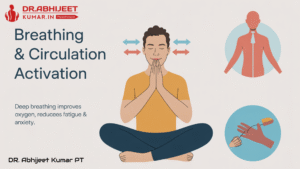
What patient sees:
Calm sitting posture with slow inhale–exhale arrows
Message on image:
“Deep breathing improves oxygen, reduces fatigue & anxiety.”
Physiotherapy purpose:
- Oxygen delivery बढ़ाना
- Exercise के लिए body तैयार करना
🧍♀️ Panel 2: Neck & Shoulder Mobility

What patient sees:
Gentle neck side-bending and shoulder rolls
Message on image:
“Relieves neck stiffness & improves blood flow.”
Physiotherapy purpose:
- Thyroid patients की neck और upper-back stiffness कम करना
- Posture सुधारना
🚶 Panel 3: Brisk Walking (Core Exercise)
What patient sees:
Woman brisk walking with upright posture
Message on image:
“30–45 minutes brisk walk = best fat-burning exercise for thyroid.”
Physiotherapy purpose:
- Metabolism activate करना
- Weight control
- Heart health improve करना
🏋️♀️ Panel 4: Strength Training (Beginner Safe)
What patient sees:
Chair-supported squat and wall push-up
Message on image:
“Builds muscle → boosts metabolism.”
Physiotherapy purpose:
- Muscle weakness improve करना
- Resting calorie burn बढ़ाना
🧘 Panel 5: Stretching & Flexibility
What patient sees:
Hamstring stretch, calf stretch, and gentle back stretch
Message on image:
“Reduces morning stiffness & body pain.”
Physiotherapy purpose:
- Joint nutrition improve करना
- Pain और stiffness कम करना
🧘♂️ Panel 6: Yoga Support (Optional)
What patient sees:
Anulom-Vilom breathing or Bhujangasana posture
Message on image:
“Controls stress hormones & improves sleep.”
Physiotherapy purpose:
- Stress-related symptom control
- Better sleep & recovery
⚠️ Infographic Safety Notes
- Start slow and increase gradually
- Avoid over-exercise
- Medicine + exercise = best result
- Always follow doctor / physiotherapist advice