Stroke Physiotherapy: Early Rehabilitation to Regain Movement & Walking
Stroke & Neurological Conditions: Role of Physiotherapy in Stroke Patients
Introduction: Why Stroke Needs Early and Regular Physiotherapy
Stroke is one of the leading causes of long-term disability worldwide. While emergency medical treatment saves life and brain tissue, physiotherapy determines how much function a patient regains afterward.
Many families commonly ask:
- “Doctor, dawa aur injection ke baad bhi physiotherapy kyun zaroori hai?”
- “Kya physiotherapy se haath-pair wapas theek ho sakte hain?”
- “Kab se physiotherapy shuru karni chahiye?”
Medical truth:
Stroke damages the brain’s control over movement, balance, and coordination. Physiotherapy helps the brain relearn lost functions through structured, repetitive, and task-oriented training.
This blog explains only STROKE, in depth, covering:
- What happens to the body after stroke
- Why physiotherapy is essential
- Stage-wise physiotherapy approach
- Common interventions used in hospitals
- Realistic recovery expectations
What Is Stroke? (Medical Understanding)
A stroke occurs when blood supply to a part of the brain is interrupted, either due to:
- Ischemic stroke: blockage of a blood vessel (most common)
- Hemorrhagic stroke: bleeding inside the brain
As a result:
- Brain cells are deprived of oxygen
- Neurons controlling movement, sensation, speech, or balance are damaged
The extent of disability depends on:
- Area of brain involved
- Severity and duration of blood flow interruption
- Speed of treatment and rehabilitation
How Stroke Affects the Body (Why Physiotherapy Is Needed)
1️⃣ Muscle Weakness or Paralysis
- One side of the body (hemiplegia / hemiparesis)
- Difficulty lifting arm or leg
- Loss of fine hand movements
2️⃣ Loss of Balance & Coordination
- Unable to sit without support
- High risk of falls
- Poor trunk control
3️⃣ Muscle Tightness (Spasticity)
- Muscles become stiff
- Abnormal postures
- Pain and restricted movement
4️⃣ Reduced Endurance
- Early fatigue
- Breathlessness on minimal activity
5️⃣ Functional Dependency
- Difficulty walking
- Difficulty eating, dressing, toileting
- Dependence on caregivers
Physiotherapy directly targets these problems.
Why Physiotherapy Is Essential in Stroke (Medical Rationale)
Physiotherapy after stroke is based on neuroplasticity — the brain’s ability to reorganize and form new connections.
Key Benefits
- Prevents secondary complications (bed sores, contractures, pneumonia)
- Maintains joint range and muscle length
- Improves strength, balance, and walking
- Encourages independent function
- Reduces long-term disability
⚠️ Without physiotherapy, even mild strokes can result in permanent stiffness and dependence.
When Should Physiotherapy Start After Stroke?
Physiotherapy should begin as early as the patient is medically stable — often within 24–48 hours in hospital.
Early physiotherapy:
- Prevents stiffness
- Improves circulation
- Reduces ICU complications
- Improves final recovery outcome
Delay in physiotherapy = delayed recovery.
Stages of Physiotherapy in Stroke Patients
Stroke rehabilitation is progressive and stage-wise, not random exercises.
🔹 Stage 1: Acute / Early Hospital Phase
Goals:
- Prevent complications
- Maintain joint mobility
- Prepare patient for upright posture
Common Physiotherapy Interventions
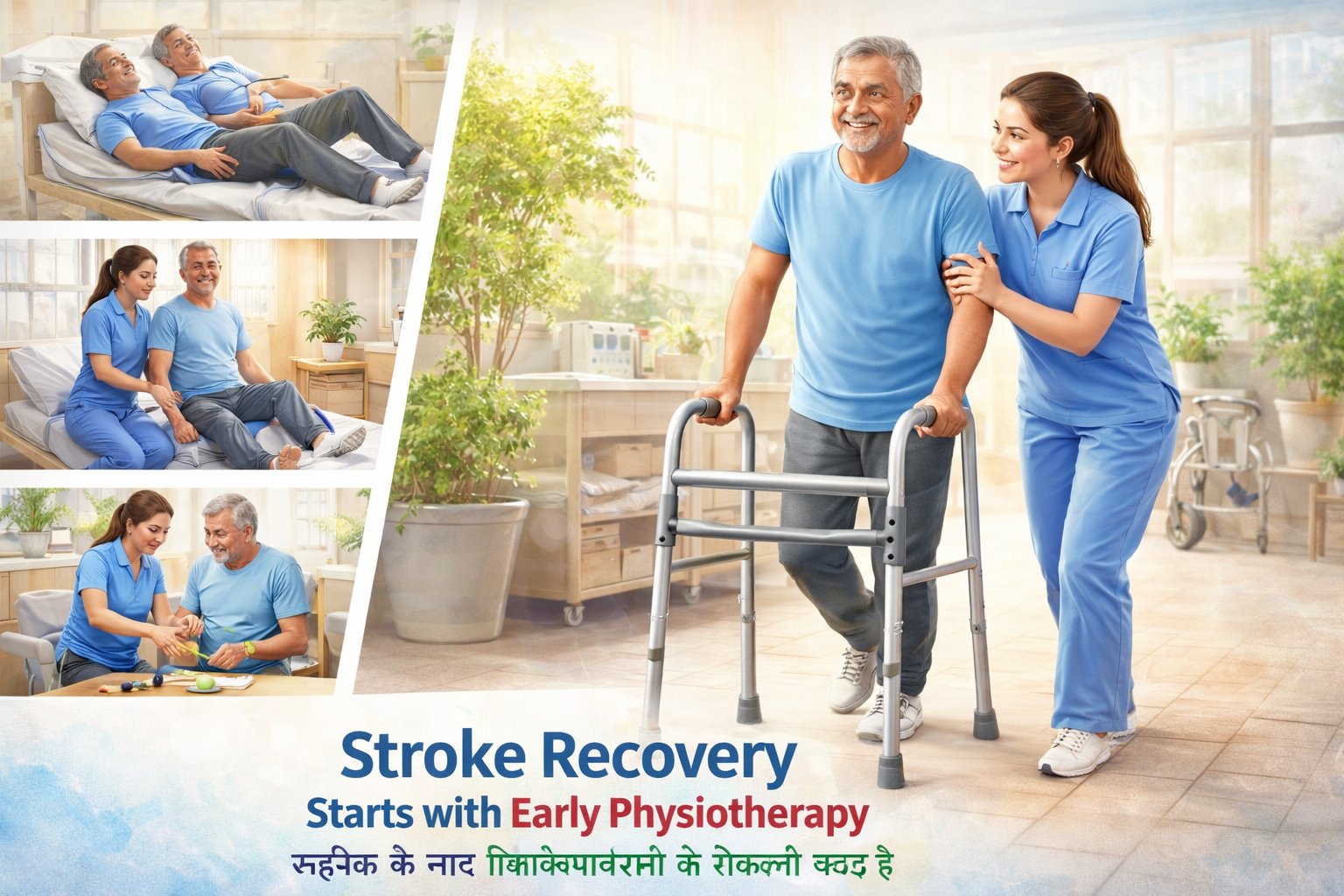
1️⃣ Bed Mobility Training
- Turning in bed
- Moving from lying to sitting
- Maintaining proper positioning
Why important:
- Prevents bed sores
- Reduces lung congestion
- Improves patient confidence
2️⃣ Passive & Assisted Movements
Therapist gently moves affected limbs through full range.
- Prevents joint stiffness
- Maintains muscle length
- Reduces pain and spasticity
3️⃣ Breathing Exercises
- Deep breathing
- Chest expansion exercises
Medical purpose: Prevent pneumonia, improve oxygenation, support early mobilization.
🔹 Stage 2: Sub-Acute Phase (Early Rehabilitation)
Goals:
- Improve sitting and standing balance
- Activate weak muscles
- Begin functional movements
1️⃣ Sitting Balance Training
- Sitting without support
- Weight shifting
- Reaching activities
2️⃣ Standing Training
- Weight bearing on affected leg
- Postural alignment correction
3️⃣ Gait Training (Walking Training)
- Step pattern correction
- Balance during walking
- Use of walker or stick if required
Medical goal: Restore safe and energy-efficient walking.
🔹 Stage 3: Arm & Hand Rehabilitation
Hand recovery is difficult because fine movements need precise brain control and spasticity develops early.
Physiotherapy Interventions
- Shoulder positioning
- Elbow and wrist control
- Weight bearing through hand
- Grasp and release training
- Functional task practice (cup holding, buttoning)
Early and regular hand therapy improves independence significantly.
🔹 Stage 4: Strength, Endurance & Functional Training
Goals:
- Improve muscle strength
- Increase walking distance
- Return to daily activities
- Resistance training
- Stair climbing
- Sit-to-stand practice
- Balance and coordination drills
Real-Life Clinical Examples
Example 1: Early Physiotherapy = Better Outcome
A 60-year-old ischemic stroke patient started physiotherapy within 48 hours.
Outcome: Walked with support in 3 weeks, independent walking by 3 months.
Example 2: Delayed Physiotherapy
A 55-year-old patient received no physiotherapy for first 3 weeks.
Outcome: Walking achieved, but hand recovery remained poor.
Early therapy clearly changed outcomes.
Common Myths About Stroke Physiotherapy
- ❌ Physiotherapy sirf 1–2 mahine ka hota hai
- ❌ Age zyada hai, recovery possible nahi
- ❌ Sirf walking hi important hai
Medical reality: Recovery continues for months to years. Hand, balance, and posture are equally important.
How Long Does Stroke Physiotherapy Continue?
- First 3 months: fastest recovery
- 6–12 months: steady improvement
- Beyond 1 year: slower but meaningful gains
Consistency matters more than speed.
Role of Hospital-Based Physiotherapy Team
- Neurologist
- Physician
- Nurses
- Speech therapist
- Occupational therapist
Team-based care gives best outcomes.
Doctor’s Medical Advice
Stroke is not the end of functional life. Physiotherapy is not optional — it is treatment.
Early, regular, and structured physiotherapy prevents disability, restores independence, and improves quality of life.
Conclusion
Stroke rehabilitation is a medical process, not just exercises.
With correct physiotherapy at the right time, the brain can relearn movement, balance, and function.
👉 Early physiotherapy = better recovery.
Stroke Physiotherapy Exercise Infographic
🟥 Panel 1: Bed Mobility (Early Stage)
Text on Image:
EN: Early movement prevents stiffness & bed sores
HI: शुरुआती मूवमेंट जकड़न और बेड सोर से बचाता है
Exercises Shown:
- Side turning
- Bridging
- Rolling in bed
🟦 Panel 2: Breathing & Trunk Control
Text on Image:
EN: Better breathing improves oxygen & recovery
HI: सही सांस लेने से ऑक्सीजन और रिकवरी बेहतर होती है
Exercises Shown:
- Deep breathing
- Trunk activation in sitting
🟩 Panel 3: Sitting Balance Training
Text on Image:
EN: Sitting balance is the first step to walking
HI: बैठने का संतुलन चलने की पहली सीढ़ी है
Exercises Shown:
- Unsupported sitting
- Weight shifting
- Reaching tasks
🟨 Panel 4: Standing & Walking (Gait Training)
Text on Image:
EN: Step by step, walking returns
HI: धीरे-धीरे चलने की क्षमता वापस आती है
Exercises Shown:
- Parallel bar standing
- Assisted walking
- Gait correction
🟪 Panel 5: Arm & Hand Rehabilitation
Text on Image:
EN: Regular practice improves hand function
HI: नियमित अभ्यास से हाथ की कार्यक्षमता सुधरती है
Exercises Shown:
- Weight bearing on hand
- Grasp & release
- Functional tasks
🟫 Panel 6: Strength & Functional Training
Text on Image:
EN: Strength builds independence
HI: ताकत आत्मनिर्भरता लाती है
Exercises Shown:
- Sit-to-stand
- Resistance exercises
- Stair practice
⚠️ Safety Message
EN: Start early. Progress slowly. Regular physiotherapy gives best recovery.
HI: जल्दी शुरू करें, धीरे-धीरे बढ़ाएं। नियमित फिजियोथेरेपी से सबसे अच्छा सुधार होता है।