Stroke Warning Signs (FAST): What Patients And Families Must Do Immediately
Patient-Focused Complete Guide – With Recovery & Physiotherapy Hope
“Achaanak Haath-Pair Kamzor Ho Gaya… Bolne Mein Dikkat”
Stroke is a medical emergency. Every minute after stroke symptoms begin,
brain cells start dying.
Yet, many patients and families delay treatment because they do not recognize early signs
or underestimate their seriousness.
Common statements heard in OPD and emergency:
- “Doctor, shayad thakaan ya BP ki wajah se hoga.”
- “Bolne mein thodi dikkat thi, phir theek ho gaya.”
- “Haath sunn ho gaya tha, par dard nahi tha.”
👉 This delay can cost life or permanent disability.
This blog explains stroke in simple, patient-friendly language, focusing on:
- Early warning signs (FAST method)
- What to do immediately
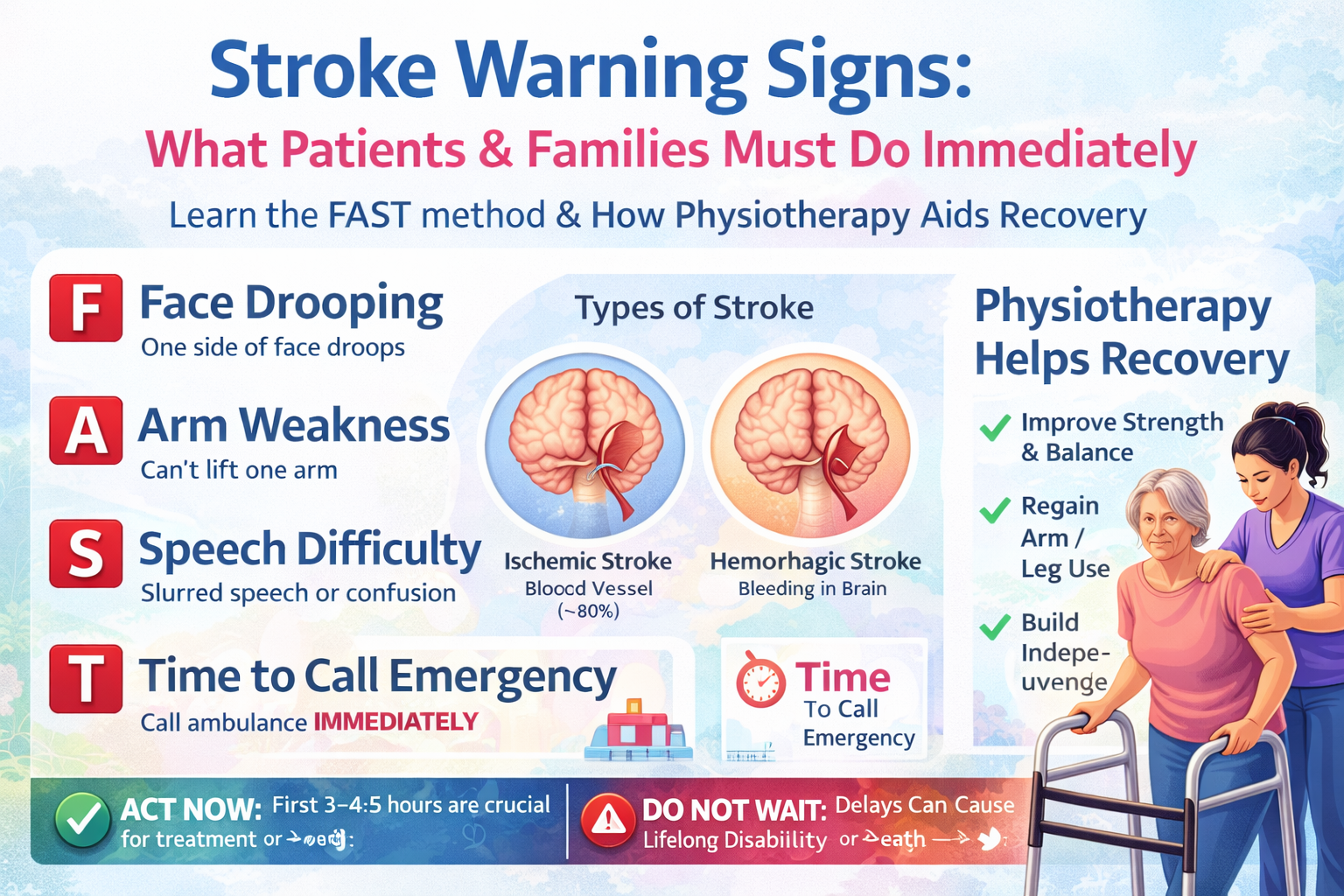
- Types of stroke
- Role of physiotherapy in recovery
- Real-life examples and hope
What Is a Stroke? (Simple Explanation)
A stroke happens when blood supply to a part of the brain is suddenly interrupted.
- Even a few minutes without blood can cause damage
- The affected brain area stops functioning properly
👉 Stroke is also called a “brain attack”, similar to how a heart attack affects the heart.
Types of Stroke (Easy to Understand)
1️⃣ Ischemic Stroke (Most Common – ~80%)
- Caused by blockage in a blood vessel
- Often due to clot, cholesterol plaque, or heart problems
2️⃣ Hemorrhagic Stroke
- Caused by bleeding in the brain
- Usually related to very high BP or weak blood vessels
👉 Both types are emergencies and need immediate hospital care.
Why Do Strokes Happen?
- High blood pressure (BP)
- Diabetes
- High cholesterol
- Smoking or tobacco use
- Heart disease
- Obesity and physical inactivity
- Stress and poor lifestyle
- Increasing age (but young strokes are rising)
⚠️ Important: Stroke can happen even if the patient looked “fine” before.
Stroke Warning Signs – The FAST Method (MOST IMPORTANT)
🟥 F – Face Drooping
- One side of face droops
- Smile looks uneven
🟥 A – Arm Weakness
- Inability to lift one arm
- Arm or leg becomes suddenly weak or numb
🟥 S – Speech Difficulty
- Slurred speech
- Unable to speak or understand properly
🟥 T – Time to Call Emergency
- Immediate hospital visit
- Do NOT wait for symptoms to improve
👉 FAST saves brain and life.
Other Early Stroke Symptoms (Often Ignored)
- Sudden dizziness
- Loss of balance
- Severe headache (especially in hemorrhagic stroke)
- Blurred or double vision
- Sudden confusion
- Difficulty swallowing
👉 Even one symptom is enough to suspect stroke.
What Should Families Do Immediately?
🚨 DO THIS
- Call emergency services immediately
- Take patient to nearest stroke-ready hospital
- Note the time of symptom onset
- Keep patient calm and lying on side if vomiting
❌ DO NOT
- Give food or water
- Give BP or sugar medicines without advice
- Massage or use home remedies
- Wait for symptoms to settle
👉 Golden window: First 3–4.5 hours are crucial for treatment.
Real-Life Patient Examples
Example 1: FAST Action Saved Life
A 62-year-old man developed slurred speech and right arm weakness.
Family recognized FAST signs and reached hospital within 1 hour.
- Clot-busting treatment given
- Minimal brain damage
- Walked independently after rehabilitation
Example 2: Delay Caused Disability
A 55-year-old woman had face drooping and mild speech difficulty.
Family waited thinking it was a BP problem.
- Reached hospital after 12 hours
- Permanent weakness in left arm and leg
👉 Delay changed life forever.
Diagnosis of Stroke
- CT scan / MRI brain
- BP and blood sugar tests
- ECG and heart evaluation
- Blood investigations
👉 Imaging confirms type of stroke and guides treatment.
Stroke Recovery: Is Improvement Possible?
👉 YES. Stroke recovery is possible.
Recovery depends on:
- Area of brain affected
- Severity of stroke
- Early treatment
- Physiotherapy and rehabilitation
Role of Physiotherapy in Stroke Recovery
- Weakness or paralysis
- Poor balance
- Difficulty walking
- Speech and swallowing issues
- Loss of independence
Physiotherapy helps the brain relearn lost functions.
Stages of Stroke Rehabilitation
🔹 Early Phase (Hospital Phase)
- Passive movements
- Positioning to prevent stiffness
- Breathing exercises
- Bed mobility training
🔹 Sub-Acute Phase
- Sitting balance training
- Standing with support
- Assisted walking
- Arm and hand activation
🔹 Long-Term Phase
- Gait training
- Strength and coordination exercises
- Functional task practice
- Community mobility
👉 Recovery is a process, not a miracle overnight.
Doctor’s Advice for Patients & Families (Dr. Abhijeet)
Stroke is an emergency, not a condition to wait on.
Recognize FAST signs and act immediately.
With timely treatment and physiotherapy, recovery and independence are possible.
स्ट्रोक के शुरुआती लक्षण: मरीज और परिवार क्या करें
FAST तरीका (सबसे ज़रूरी)
- F: चेहरा टेढ़ा होना
- A: हाथ-पैर में अचानक कमजोरी
- S: बोलने में दिक्कत
- T: तुरंत अस्पताल जाएँ
👉 FAST जान बचाता है।
स्ट्रोक के बाद फिजियोथेरेपी की भूमिका
- चलना सुधरता है
- हाथ-पैर में ताकत आती है
- संतुलन और आत्मनिर्भरता बढ़ती है
👉 सुधार संभव है, उम्मीद रखें।
Physiotherapy Exercise Infographic – Stroke Recovery
🟥 Panel 1: Early Stage – Bed Mobility
English (Overlay):
Early movement prevents stiffness & complications.
Hindi (Overlay):
शुरुआती मूवमेंट जकड़न और बेड कॉम्प्लिकेशन से बचाता है।
🟦 Panel 2: Breathing & Trunk Control
English (Overlay):
Better breathing improves oxygen and recovery.
Hindi (Overlay):
सही सांस लेने से ऑक्सीजन और रिकवरी बेहतर होती है।
🟩 Panel 3: Sitting Balance Training
English (Overlay):
Sitting balance is the first step to walking.
Hindi (Overlay):
बैठने का संतुलन चलने की पहली सीढ़ी है।
🟨 Panel 4: Standing & Walking Training
English (Overlay):
Step by step, walking returns.
Hindi (Overlay):
धीरे-धीरे चलने की क्षमता वापस आती है।
🟪 Panel 5: Arm & Hand Recovery
English (Overlay):
Regular practice improves hand function.
Hindi (Overlay):
नियमित अभ्यास से हाथ की कार्यक्षमता सुधरती है।
🟫 Panel 6: Strength & Functional Training
English (Overlay):
Strength builds independence.
Hindi (Overlay):
ताकत आत्मनिर्भरता लाती है।
⚠️ Safety Message (Infographic Footer)
English:
Start early. Progress slowly. Regular physiotherapy gives best recovery.
Hindi:
जल्दी शुरू करें, धीरे-धीरे बढ़ाएं। नियमित फिजियोथेरेपी से सबसे अच्छा सुधार होता है।